
Vegan Ube and Cheese Pandesal (Filipino Sweet Bread Rolls with Purple Yam and Cheese Filling)
Here’s a vegan take on the ube (purple yam) pandesal that have taken the Philippines by storm in the past few months. These pandesal, also known as Filipino Sweet Bread Rolls, are filled with an ube (purple yam) filling and some vegan mozzarella cheese—imagine the blend of sweet with a little saltiness from the cheese.
Ingredients
Ube Puree (see notes)
- 1/4 cup ube powder or purple yam powder (32g) see notes
- 1 cup hot water
Dry Ingredients
- 4 cups all purpose flour (520g) ,plus around 4 tbsp more if needed (see notes)
- 6 tbsp sugar (90g), see notes
- 1 1/2 tsp instant yeast
- 1 tsp salt
Wet Mixture
- 1 cup warm soy milk or oat milk
- 3 tbsp neutral oil (I used vegetable oil)
- 1 tsp ube extract optional
For Filling
- 1 cup ube halaya or spread, see homemade recipe here
- 1 cup vegan mozzarella cheese shreds or vegan mozzarella block, sliced into 20 cubes (see notes)
For Coating
- 1/4 to 1/2 cup fine breadcrumbs or almond meal
Instructions
Ube Puree
- In a medium heat proof bowl, mix together the ube powder and hot water. Mix until the powder has dissolved and the mixture is smooth.See notes below for an alternative.


Dry Ingredients
- In a large bowl, mix together all dry ingredients.


Wet Ingredients
- Mix the warm soy milk and oil. Pour it in the flour mixture while mixing. Add in the ube puree and ube extract (if using) as well .


Kneading the Dough
- I used a spatula to mix everything together at the start then eventually used my hands to knead everything together. Keep mixing until a dough is formed. It’ll be easier to mix everything together with your hands or a stand mixer if you have one.

- If using your hands, you can rub your hands with some oil to prevent the dough from sticking. This will be a VERY STICKY dough so it can be quite hard to handle at the start.
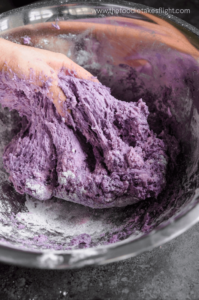
- If you still find it sticky after kneading for 4 to 5 minutes, you can gradually add 1 tbsp more all purpose flour at a time.

- Keep kneading until the dough comes together and becomes smooth. I just kneaded mine in the same large bowl I mixed it in for minimal clean up.

- Remove the dough from the bowl. Brush some oil on your bowl and then place back the ball of dough into the bowl.

- Cover with a damp towel and leave to rise for 1 hour in a warm spot in your home or inside your oven until doubled in size.

- Flour your work surface. When the dough has risen, remove the ball of dough and transfer it to the floured surface. You can check out my video below to see a complete step-by-step on how to make these.

- Divide the ball of dough into 2. Cover 1 ball with a towel to prevent it from drying while you work on one. From there, you can shape each piece into a large ball and then punch a hole in the centre.
- Carefully stretch the dough until you have a large ring then divide it into 10 pieces of around 58 to 60 grams each.
- Repeat this for the other piece of dough until you have 20 pieces of sliced dough in total.

- Place the balls of dough in a tray and cover it with a towel to prevent them from drying out.


Shaping the Pandesal
- To work on each pandesal, get a piece of dough. Shape it into a ball and carefully flatten it on your surface. You can see the video below for a better idea.
- For the coating, place the bread crumbs or almond meal on a shallow tray or plate.

- Place around 1/2 to 1 tbsp of the ube filling then 1/2 tbsp or one small cube of cheese on top of the ube filing.

- Grab the edges of the dough and crunch it all together at the centre. Pinch the centre together to seal it well and prevent the filling from seeping out.

- Roll the pandesal on your flat working surface to get a round ball and also to evenly seal the edges.

- Transfer the pandesal on the plate with the bread crumbs/almond meal and then roll around the plate/tray to coat in the bread crumbs.

- Transfer the pandesal on your lined baking tray. I used parchment paper to line my 10x13-inch tray. Leave around 3/4 to 1-inch space between each pandesal on the tray since they’ll continue to expand as it proofs.

- Repeat this for the rest of the pieces of dough and place them all on the tray.


Proofing
- Cover the pandesal on the tray with a towel, and leave to proof for 20 to 30 minutes. The pandesal will rise and the gaps between each one will disappear.
- While the pieces of pandesal are proofing, heat your own to 180C/350F.
Baking the Pandesal
- Bake the pandesal for 20 to 22 minutes or until the top is hard and when you press down on it you’ll notice a slight crunch. The insides will be really airy and fluffy.

- Carefully separate the pandesal and enjoy each piece while hot!

- These are best enjoyed warm.


Storage
- If you have leftovers, you can simply place them in an air-tight container at room temperature for up to 2 days or refrigerate them for up to 1 week. You can simply reheat these in an oven toaster for a few minutes to enjoy warm.
- To prolong shelf life, you can freeze them for months and just thaw them before reheating in the oven toaster.
Making Plain Pandesal
- If you'd like to make these without the filling, I suggest increasing the amount of sugar to 8 tbsp or even doubling it (12 tbsp).


WATCH Video
Notes
UBE PUREE
For the ube puree, if you don't have ube powder but have some fresh ube or purple potatoes, you can mash these up and turn into a puree with some water. I would recommend around 1 cup of mashed cooked ube/purple sweet potato with 1 cup (more or less) or water until you have a puree consistency. You can also opt to add some ube flavouring (around 1 tsp) to get more ube flavour.SUGAR
- if you want a sweeter pandesal, you can increase to 8 tbsp (1/2 cup) of sugar. I personally prefer it less sweet since the filling is already sweet.
- If you're making plain pandesal without the filling, I suggest increasing the amount of sugar to 8 tbsp or even doubling it to 12 tbsp.
Ube Powder
I couldn't find good ube powder that yielded a nice thick puree-liked consistency so I opted for this Lilac Taro Yam Powder mix which had a really beautiful deep colour when reconstitutedBread crumbs
I actually didn't have fine bread crumbs so I used Japanese or panic bread crumbs and just quickly processed them so there were still some larger bits. You can also use almond meal!Adding extra All-Purpose Flour
The dough will be very sticky at the start so you can add 1 tbsp more flour at a time as you knead.NUTRITIONAL INFO
Serving: 1pandesal | Calories: 147kcal | Carbohydrates: 25g | Protein: 3g | Fat: 4g | Saturated Fat: 1g | Polyunsaturated Fat: 1g | Monounsaturated Fat: 1g | Trans Fat: 1g | Sodium: 173mg | Potassium: 51mg | Fiber: 1g | Sugar: 4g | Vitamin A: 3IU | Vitamin C: 1mg | Calcium: 8mg | Iron: 1mg
DID YOU MAKE THIS RECIPE?Please leave a rating or comment and share a photo on Instagram, and tag me @thefoodietakesflight or use #thefoodietakesflight :)